Showing posts with label #malaria. Show all posts

Saturday, April 23, 2016

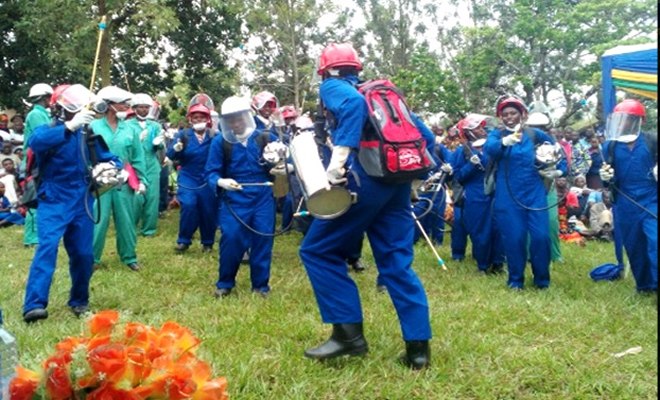
Rwanda Army Joins Battle Against Malaria


Rwanda Army Joins Battle Against Malaria

Friday, December 6, 2013

VOA’s news programme, Africa 54, Minister of Health Agnes Binagwaho's interview


Health Agnes Binagwaho discusses how


Rwanda managed to lower its rates of deaths and new


infections of HIV, TB, and malaria in the
 
past 10 years. 


Her interview starts at the 16:20 mark.

http://www.voanews.com/media/video/africa-54/1802655.html?z=3589&zp=1

Thursday, November 15, 2012

Congratulations, Dr. Mark Dybul


I am delighted to share that US Ambassador Mark Dybul, former leader of the US President’s Emergency Plan for AIDS Relief (PEPFAR), has been announced as the next Executive Director of the Global Fund to Fight AIDS, Tuberculosis, and Malaria. Mark is an inspiring choice by the Global Fund’s Board of Directors. I have believed in his candidacy for this position since the outset, and have great faith in what he can bring to one of global health’s most vital institutions.

Mark has long understood that global health must fundamentally be about equity and the fulfillment of the human right to health – not simply about addressing infectious diseases in far-off places. During his work to launch and expand PEPFAR, he demonstrated time and again that he believes in a person-centered approach to health care delivery and that he knows how to build strong systems that do not leave any among the most vulnerable out of benefits. Mark’s leadership in the global HIV/AIDS response helped to set a new paradigm for global health partnership, transitioning the world towards a long-term approach to tackling the most deadly pandemic in centuries while strengthening systems that have increased access to primary and specialty care for a wide range of diseases.

I am hopeful that Mark’s appointment to lead the Global Fund will help to usher in a new era of results-oriented programming that builds on the legacy of his predecessors, Michel Kazatchkine and Gabriel Jaramillo, while ensuring that the Fund stays true to its roots as an instrument truly of the people. I look forward to fruitful future collaborations with Mark and the Global Fund, and believe that the time for an integrated, solidarity-driven, and country-owned response to global health challenges is within our grasp. There is much work ahead, but the future is bright. Congratulations, Mark!

Sunday, November 11, 2012

Country Ownership to Strengthen Synergies Between Global Health Initiatives and Health Systems


On Thursday, 8 November, colleagues in the Ministry of Health and I published a brief Comment in Journal of the Royal Society of Medicine: Short Reports responding to a review of interactions between global health initiatives (like the Global Fund and PEPFAR) and country health systems. We shared Rwanda's perspective on the importance of true country ownership in promoting integration and maximizing synergies.


Country Ownership to Strengthen Synergies Between Global Health Initiatives and Health Systems
Agnes Binagwaho, Sabin Nsanzimana, Corine Karema, Michel Gasana, Claire M. Wagner, and Cameron T. Nutt

As policymakers and researchers in Rwanda's health sector, we applaud Josip Car and colleagues' review of interactions between Global Fund investment and country health systems.1 Their trenchant analysis may not close the door on confidently advanced claims about the dangers of global health initiatives that are not based upon rigorous evidence, but it has helped to raise the bar for the debate.Several recent studies focused on Rwanda (that either did not fall within Car et al.'s timeframe or did not specifically investigate Global Fund programs and were thus not included in the review) together provide robust support for the argument that interventions explicitly designed to combat HIV/AIDS, tuberculosis, and malaria can be implemented in such a way as to strengthen the overall health system.2-4

In fact, Rwanda's reductions of greater than 75% in mortality due to AIDS and tuberculosis between 2000 and 2010 were accompanied by a 70% decline in child mortality and a 60% decline in maternal mortality over the same timeframe.5 This was not a fortunate accident, but due to collaborative planning with civil society and development partners, and true country ownership of program implementation and evaluation.

From the beginning of Rwanda's AIDS response, the public sector has been committed to constructing platforms of care able to address multiple chronic and acute conditions. When a clinic is built and staffed to offer HIV services to women, the same woman trying to prevent vertical HIV transmission to her unborn child will also require a safe place to deliver as well as a trained birth attendant. So will her neighbors, whether HIV- positive or not.

As is often said in the Ministry of Health, "if you give Rwanda money to help the youngest child born today, we will ensure that it also helps the oldest person by tomorrow." When implemented according to principles of authentic partnership and when investing in public infrastructure and human resources, disease-specific global health initiatives can not only achieve positive spillover effects, but can also catalyze the development of comprehensive and equitable primary care systems in the poorest countries.
The time has come for scholars and policymakers to move past unfounded worries about whether to invest in the pandemics of AIDS, tuberculosis, and malaria; what we must now devote our full attention to is the question of how best to harness synergies and maximize impact in the pursuit of health as a human right.


References 
1 Car J, Paljarvi T, Car M, Kazeem A, Majeed A, Atun R. Negative health system effects of Global Fund's investments in AIDS, tuberculosis and malaria from 2002 to 2009: systematic review. J R Soc Med Sh Rep 2012;3:70. 
2 Price J, Leslie JA, Welsh M, Binagwaho A. Integrating HIV clinical services into primary health care in Rwanda: a measure of quantitative effects. AIDS Care 2009;21:608-614. 
3 Kalk A, Groos N, Karasi JC, Girrbach E. Health systems strengthening through insurance subsidies: the GFATM experience in Rwanda. Trop Med Int Health 2010;15:94-97. 
4 Shephard D, Zeng W, Amico P, Rwiyereka AK, Avila-Figueroa. A controlled study of funding for Human Immunodeficiency Virus/Acquired Immunodeficiency Syndrome as resource capacity building in the health system in Rwanda. Am J Trop Med Hyg 2012;86:902-907. 
5 WHO: World Health Statistics 2012. World Health Organization, Geneva 2012.

Friday, July 13, 2012

Global Health Solidarity at a Crossroads

On 5 July 2012, I published an op-ed in Project Syndicate about the importance of fully funding The Global Fund to Fight AIDS, Tuberculosis, and Malaria. You can read the full text below, or access the piece on Project Syndicate's website here.

Global Health Solidarity at a Crossroads
05 July 2012

KIGALI – A decade ago, the global community stood together to declare that where people live should not determine whether they live or die when confronted by the scourge of AIDS, tuberculosis, or malaria.

This act of solidarity – unprecedented in human experience – led to revolutionary advances in promoting health care as a human right. The Global Fund to Fight AIDS, Tuberculosis, and Malaria, along with the United States President’s Emergency Plan for AIDS Relief (PEPFAR), quite literally changed the course of history. Programs directly supported by the Global Fund have saved nearly eight million lives since 2002 – an average of more than 4,400 lives every day.

But, while much has been accomplished, much more remains to be done – and the Global Fund needs at least $2 billion to reverse a funding freeze that is in place through 2014. So the world now plays a waiting game to see whether governments will step up and fill the gap.

To be blunt, many of the world’s largest economies are not fulfilling their financial pledges to the Fund. Their politicians cite budget constraints and the need to prioritize domestic programs over fighting diseases that disproportionately kill the world’s poorest.

My country, Rwanda, has been a recipient of Global Fund grants since 2002. Just 18 years ago, our society was torn apart by a brutal genocide that killed more than one million people. Today, Rwanda is a peaceful country full of promise and hope, with one of the world’s fastest-growing economies.

With Global Fund support for our national institutions, we have achieved universal access to lifesaving antiretroviral therapy for people living with HIV, and we have stabilized HIV prevalence at around 3% of the population. Similarly, Rwanda’s tuberculosis program has become a model for Africa, and all Rwandan families now have access to insecticide-treated bed nets to prevent malaria, contributing to an 87% drop in cases during the last seven years.

Integration of services for infectious diseases and primary care has contributed to some of the steepest declines in child and maternal mortality ever observed. And, as life expectancy in Rwanda continues to climb (from below 30 in 1995 to 55 in 2010), we are now taking action against non-communicable diseases such as heart disease, cancer, and diabetes. The flexible, country-owned support provided by the Global Fund has been crucial to our success.

My country is living proof that investing in health is not only the right thing to do, but that it can also create virtuous cycles that promote security and development. In fact, after receiving Global Fund support for years, Rwanda recently made its first donation of $1 million to the Fund.

Unfortunately, infectious diseases are far from under control around the world. Less than a quarter of the world’s children living with HIV have access to treatment, and up to a million people still die of malaria each year. And, alarmingly, only one in six patients with drug-resistant tuberculosis currently receives proper treatment. Moreover, reports of “totally drug-resistant tuberculosis” have recently emerged from India.

Policymakers would do well to remember that it only takes one airplane flight for such a pathogen to go global. Infectious diseases neither respect national borders nor conveniently follow economies into recession. History has shown that retreating from the fight against an epidemic can lead to a renewed plague that is immune to our best drugs, requiring far more expensive measures to control.

Our choice could not be clearer: either we resolve to answer the call of history and provide the Global Fund with the resources that it needs, or we allow political lassitude to undermine a decade of progress and consign untold thousands to preventable deaths. Investing now, on the other hand, would pay off in the long term: just $6 billion more per year for the AIDS response today would save more than $40 billion in averted treatment costs alone over the next decade.

Today, the Global Fund stands at a crossroads. The international community’s regard for the health of the world’s poorest in the face of financial uncertainty will be a standard by which history measures not only our ability to stand together in weathering economic upheaval, but also our capacity for justice.

Now is the time for donor countries, including middle- and low-income countries, to rise to the challenge and ensure that the Global Fund has the resources needed to accept new grant applications as soon as possible. The costs of inaction are morally – and economically – untenable.

Saturday, February 4, 2012

Progress in Rwanda's Fight Against Malaria

On Monday, 30 January, the African Leaders Malaria Alliance (ALMA) presented to our President, His Excellency Paul Kagame, with a 2012 ALMA Award for Excellence in recognition of Rwanda’s tremendous progress in malaria control. 

This is truly a well-deserved honor, as he has supported the Ministry of Health and its partners across the public sector, civil society, and the international community  in achieving a 70% decrease in malaria incidence and a 60% decrease in malaria mortality between 2005 and 2010. These dramatic results are the latest data from the 2010 Demographic and Health Survey (which will be publically available online next month). 

Last week, I had the great pleasure of launching a new malaria control campaign in Nyagatare District, which alone accounts for 40.4% of malaria incidence across the whole of Rwanda. A cross-sectorial approach to increasing utilization of insecticide-treated bed nets and clearing areas of standing water where mosquitoes breed will help to dramatically reduce this unacceptable figure in the next three months and contribute to the Government’s goal of eliminating malaria within national borders by 2015.

I offer my deepest heartfelt congratulations to all those who have contributed to this success, from His Excellency to the health workers at the community level. Let us all take this opportunity to rededicate ourselves to the fight against malaria and for a Rwanda where no one dies needlessly of preventable and treatable diseases.

Now we must explore sustainable approaches to eliminating malaria as a public health priority. For this to occur, we must have factories manufacturing long-lasting insecticide-treated bed nets and appropriate anti-malarial drugs. We will also need to strengthen cross-border collaborations, including the improvement of anti-counterfeit drug activities and the harmonization of prevention and treatment strategies across the region. When we have achieved our goals, Rwanda’s children will have peaceful nights and parents will not fear when they hear the “bzzzzz” noise coming across the room, for it will not be a mosquito but rather a simple fly suffering from insomnia.

(Image courtesy of Rwanda News Agency)